
The Triune Brain
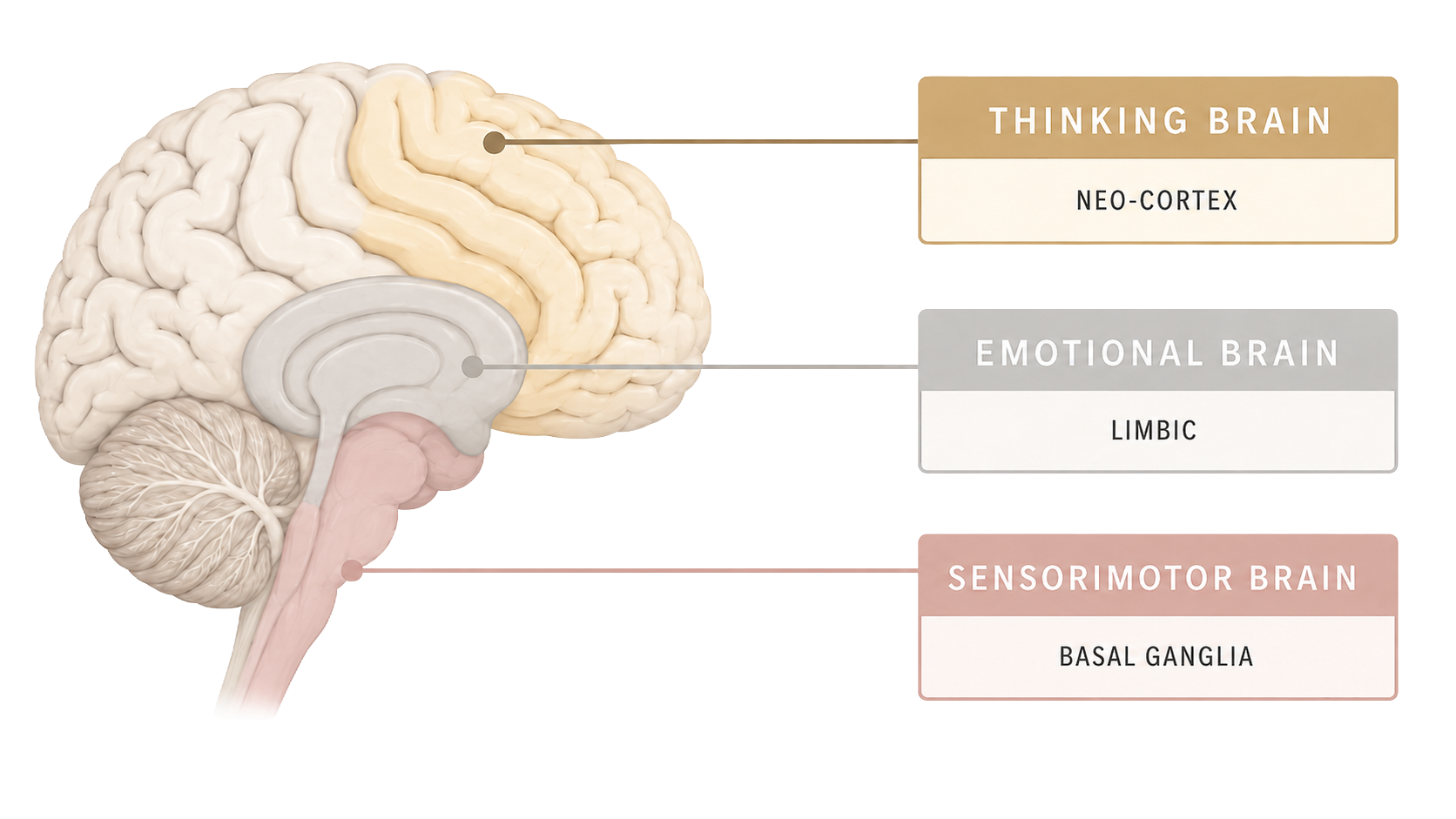
Someone asks you for one more thing. You're already stretched thin, already running on fumes, and before you've even had a chance to think it over, "sure, no problem" is already out of your mouth. Ten minutes later, you're annoyed, maybe even a little furious, and you can't quite explain to yourself why you agreed to something you didn't have room for.
That's not a willpower problem. Your brain isn't one driver, it's three, and the one who actually wanted to say no often doesn't get a vote until it's too late.
The Thinking Brain
Neuroscientist Paul MacLean proposed this idea back in the 1960s, and while today's neuroscience knows the brain is far more interconnected than three neat parts, the model still holds up as a useful way to understand what's happening underneath patterns like over-functioning, people-pleasing, or feeling disconnected from your own body.
Picture three drivers who take turns, or sometimes wrestle for control, depending on the situation.
THE LEVELS
The Emotional Brain
The Backseat Driver With a Long Memory
This one holds onto every close call you've ever had, going all the way back. It's the emotional system, home to your amygdala (which works like an alarm that flags danger) and your hippocampus (which files away memories, both good and painful). If you grew up needing to read a room, anticipate someone else's mood, or earn safety by being easy to be around, this driver got a lot of practice early, and it's still applying that same training today, even in relationships where it isn't actually needed anymore.
Sensorimotor Brain
The Autopilot
This is the oldest system on board, and it's not interested in your opinion. It runs your breathing, your heart rate, your digestion, all without you thinking about any of it. When something startling happens, or something that even resembles old danger, it acts first and explains later. It doesn't wait for permission. If saying yes, staying agreeable, or keeping things calm once kept you safe, this is the system that learned that lesson and never stopped applying it.
When The Wrong Driver Has The Wheel
In a calm moment, these three communicate well enough. But under enough pressure, real or remembered, that communication breaks down. The Autopilot and Backseat Driver take over, and the Actual Driver gets shoved into the back seat, unable to reach the wheel. This is why you can know, intellectually, that you're allowed to rest, allowed to say no, allowed to take up space, and still feel your body do the exact opposite of what you meant to do.
You're not failing to apply what you know. The part of you that holds that knowledge has, quite literally, lost access to the steering wheel.
How Does This Show Up In Everyday Life?
This plays out differently for everyone, but here are a few examples of some of those held patterns in the body.
Saying yes before you've decided to
You agree to things, take on more, or smooth things over, often before you've consciously weighed whether you have the capacity. This isn't a lack of boundaries so much as a Backseat Driver who learned, early, that disagreement or disappointing someone came with a cost. Guilt often shows up right after you do manage to say no, as if the system is bracing for a consequence that isn't actually coming this time.
Running until you can't
The Autopilot can stay in "go" mode for a long time, sometimes years, holding everything together while you function at a high level. It doesn't announce when it's running on empty. It just eventually stalls, and burnout can feel sudden even though it was building the entire time.
The body that won't get the memo
You understand your patterns. You've done the reading, maybe years of prior therapy, and you can explain exactly why you react the way you do. And your body still tightens, still braces, still reacts like the old danger is current. That gap between insight and sensation is the “Actual Driver’ understanding the road while the other two are still driving.
Ending up in familiar territory
If you keep finding yourself in relationships that echo old dynamics, this is often the Backseat Driver mistaking familiar for safe. It's not choosing poorly on purpose. It's recognizing a pattern it already knows how to navigate, even when that pattern isn't actually good for you anymore.
The Actual Driver
This is your neocortex: the part of you that can plan, reason, weigh options, and reflect. It's the one who, given the chance, would probably say "actually, I don't have capacity for that right now." The trouble is, by the time it gets a say, the Autopilot and Backseat Driver have often already responded on your behalf.
THE TWO HIGHWAYS TO PROCESSING
There are different ways we can support the brain and nervous system in therapy. One way to understand this is to imagine that healing can happen through two different highways: the top-down highway and the bottom-up highway.
Neither highway is better than the other. They simply support different parts of our system.
The Top-Down Highway
Top-down therapy talks to the Actual Driver. Approaches like CBT work by reframing thoughts and building new ways of interpreting situations, essentially giving the Actual Driver better tools and a clearer map. This can genuinely help, especially when the Actual Driver already has reasonable access to the wheel and just needs support to use it well.
The Bottom-Up Highway
The bottom-up highway begins with the body and nervous system.
Bottom-up therapy talks to the Autopilot and the Backseat Driver directly. Approaches like somatic therapy, EMDR, DBR and IFS work with the body and nervous system rather than with thoughts alone, helping recalibrate what the Autopilot treats as dangerous and updating what the Backseat Driver is still holding onto. This tends to matter most for patterns that keep repeating no matter how well you understand them, since insight alone doesn't always reach the systems that drive the behaviour.
Choosing the Right Route
For a lot of people, especially those who've already done a fair amount of the thinking work, real change comes from adding the other kind: helping the systems underneath finally catch up to what you already know.
Where to go from here
You're not overreacting, and you're not failing at something everyone else finds easy. Three different systems are trying to keep you safe, using strategies that made sense once and may not fit anymore. Therapy can help reopen the lines between them, so more of your life gets driven by the version of you who actually wants to be behind the wheel.
Book a consultation to get started.