
The Triune Brain
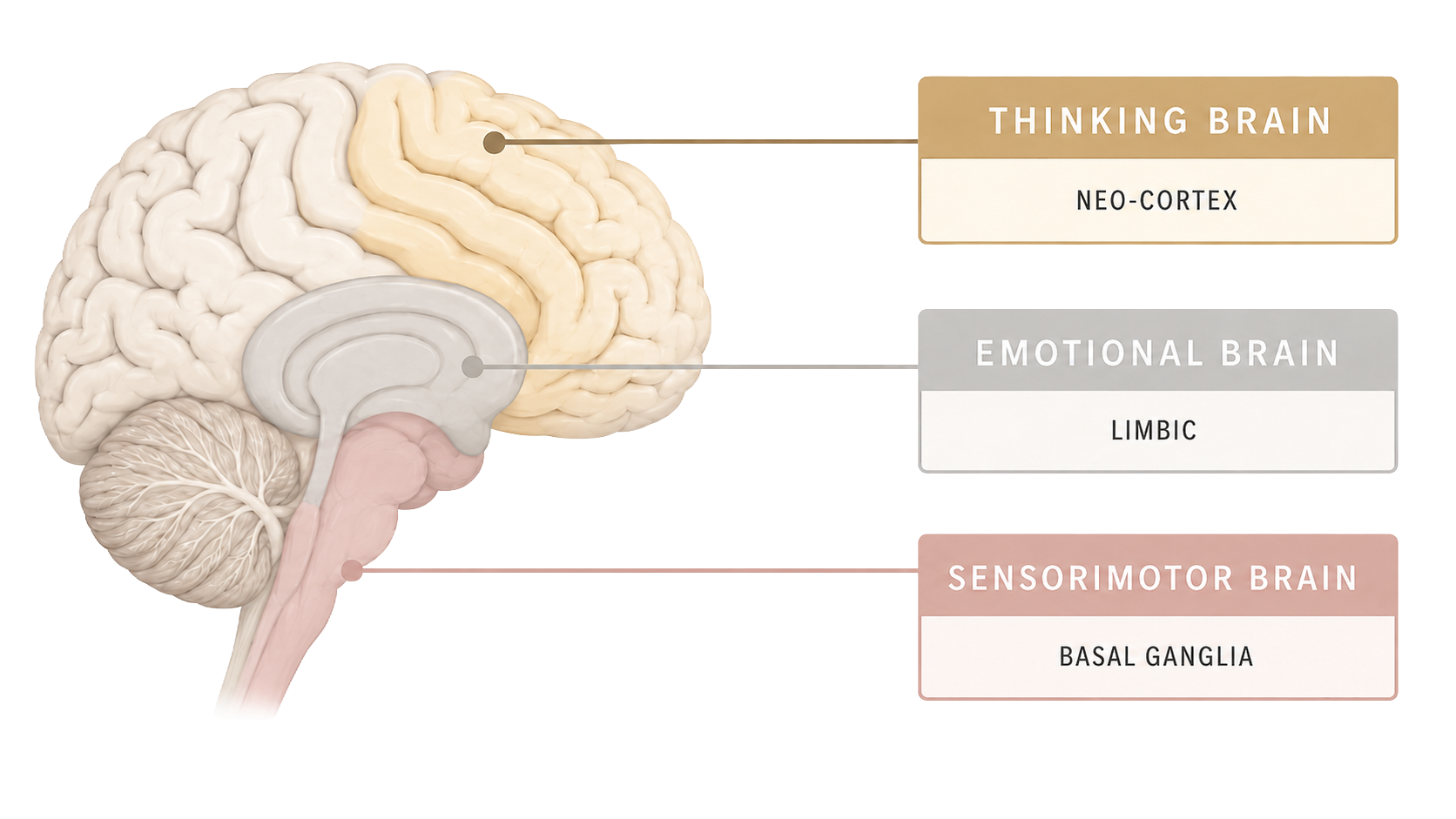
One way to understand the brain and nervous system is to imagine it like being in a car.
When everything is working well, there is communication between the driver, the dashboard, and the engine. The driver can steer, make decisions, slow down, speed up, and choose the best route. The dashboard gives important information, like when something about the car needs attention. The automatic breaks help the car respond to life threatening situations.
Our brain and nervous system work in a similar way.
We have parts of the brain that help us think and reflect, parts that help us feel and remember, and parts that help the body respond instinctively when something feels unsafe. When these levels of our brain work together, we are more grounded present and able to respond rather than react.
But when stress or trauma shows up, the system can shift quickly. The dashboard of our car may begin to signal a warning. The breaks in the car may come on automatically. The driver may have a harder time staying in charge.
This does not mean something is wrong with us. It just means the nervous system is trying to protect us.
The three-part brain model, the triune brain, is a simplified way of understanding something much more complex. The brain is deeply interconnected, but this model can still help us understand why we sometimes react before we can think, why emotions can feel so powerful, and why healing often requires us to involve both the mind and the body.
The Thinking Brain
THE LEVELS
The Emotional Brain
The emotional brain is like the temperature of the pot.. It helps us notice when there is threat and perceived danger. Our emotional alarm system, the amygdala, is connected to memory, attachment, and our ability to sense whether something feels safe or unsafe. When the amygdala senses danger, it alerts the rest of the brain and body so we can respond quickly.
This can be very helpful when there is a real threat. The challenge is that the alarm system can also be shaped by past experiences. Sometimes something in the present moment can remind the nervous system of something from the past, even if we do not consciously realize it right away. It can be prone to false alarms as this level of the brain ultimately prioritizes our survival, which means that false positives is much preferred to than false negatives. It’s much better for our survival to be ready to put a fire out that’s not there than to not even know there’s a fire there at all.
When the emotional brain sounds the alarm, the whole system can shift.
We may feel anxious, panicked, defensive, angry, ashamed, overwhelmed, or flooded. It may feel like the dashboard is flashing warnings all at once. Even if part of us knows we are safe, another part may feel like something is wrong and needs to be handled immediately.
This is why we can sometimes understand something logically, but still feel deeply activated emotionally despite logical reasoning. The thinking brain may know, “I am okay,” while the emotional brain is still sounding the alarm.
Sensorimotor Brain
The sensorimotor brain, or body brain, is like the emergency response system.
This is the part of the brain and nervous system that helps the body respond quickly. It is connected to movement, impulse and survival defences - our fight, flight or freeze. It also controls other automatic functions important in our daily life like our breathing, our heart rate and our digestion.
The body brain doesn’t need words to communicate but rather, it speaks through sensation and impulses. It doesn’t reason - it just acts. When a basketball is coming at us, we just move out of the way.
When the body senses danger, it may respond before the thinking brain has time to understand what is happening. It’s as though the emergency breaks is activated even before the driver is aware of the situation. In these moments, our body goes into instinct and routined patterned ways of being to ensure that we survive the threat.
These patterned ways of being is often from past experiences and the response often doesn’t match our present situations. For some people, especially after chronic stress or trauma, the body can stay braced for danger or move into shutdown more easily. It is like the car has learned to expect unsafe roads, even when the current road is calm.
The thinking brain is like the steam rising out of a boiling pot. This is the part of the brain that helps us steer, make decisions, plan ahead, problem-solve, use language and reflect. When the thinking brain is available, we can pause and ask, “What is happening right now?” or “How do I want to respond?”
When this part of the brain is online, it helps us stay flexible and allows us to slow down, process complex information and respond accordingly.
When stress becomes overwhelming, the thinking brain shut down and become harder to access. It is as though the pot on the stove is boiling and the water in the pot is splashing out and more smoke is occurring.
In these moments, it can be difficult to think clearly as our amygdala, our emotional brain, may hijack our nervous system. Our reasoning brain begins to shut down in order to prioritize survival through our instinctive drives. We may often feel out of control during these periods as our nervous system takes the wheel to steer us back to safety.
THE TWO HIGHWAYS TO PROCESSING
There are different ways we can support the brain and nervous system in therapy. One way to understand this is to imagine that healing can happen through two different highways: the top-down highway and the bottom-up highway.
Neither highway is better than the other. They simply support different parts of our system.
Top-down processing can help us understand our patterns, name what is happening, and create new meaning whereas bottom-up processing support our body and nervous system to process what may be held beneath words. When these two highways begin to connect, the whole system can start working together again. The driver can come back online. The dashboard can stop flashing constant warnings. The emergency breaks can release and settle.
Therapy often involves learning which route is needed in the moment. Often times, beginning with words can be helpful to get that process started and to build the understanding of what’s happening. However, other times, beginning with the body to help the car be in good condition before driving it might be necessary. Both are important routes needed to rebuild the bridge back to integration and wholeness.
The Top-Down Highway
The top-down highway begins with the thinking brain.
This route uses reflection, language, insight, problem-solving, and meaning-making. It is like starting with the driver of the car. The driver looks at the map, notices the road, thinks through what is happening, and decides where to go next.
In therapy, top-down approaches may include exploring thoughts, beliefs, patterns, stories, and behaviours. This can be very helpful when we are able to think clearly and reflect on our experience with some distance.
However, when the nervous system is highly activated or shut down, the thinking brain may not be fully available. In those moments, it can feel like the driver is trying to steer while the alarm is blaring, the gas pedal is stuck, or the brakes have locked. This is why insight alone does not always shift what we feel in the body.
The Bottom-Up Highway
The bottom-up highway begins with the body and nervous system.
This route starts with sensation, movement, emotion, breath, impulse, and the body’s survival responses. It is like starting with the engine, brakes, gas pedal, and dashboard signals before asking the driver to make sense of the whole situation.
In therapy, bottom-up approaches may include noticing body sensations, tracking nervous system responses, grounding, resourcing, somatic awareness, EMDR, or other approaches that directly work with the body and emotional brain.
This can be especially helpful when stress or trauma is not just something we think about, but is actually still held and felt in the body. Sometimes the body needs to experience safety before the thinking brain can fully understand that safety is possible.
THE ROUTE TO REPAIRING THE HIGHWAY
Choosing the Right Route
Different therapeutic approaches support different parts of the brain and nervous system. Using the car metaphor, some approaches begin with the driver, while others begin with the engine, brakes, gas pedal, and alarm system.
When the system is running smoothly, the driver can steer clearly. We can think, reflect, make choices, and decide which direction to take. But when the alarm is blaring, the gas pedal is stuck, or the brakes have locked, simply telling the driver to “calm down” or “think differently” may not be enough. The whole system may need support before the car can feel safe to drive again.
THINKING BRAIN Benefits of Mindfulness and Therapy
Mindfulness and therapy can help bring the thinking brain back online.
They can strengthen the part of us that notices what is happening without immediately reacting. Over time, this can help create more space between a feeling and a response. Instead of being pulled instantly into an old pattern, we may be able to pause, orient ourselves, and choose what happens next.
EMOTIONAL BRAIN Benefits of Mindfulness and Therapy
Mindfulness and therapy can help us understand the alarm rather than simply trying to turn it off.
Instead of seeing emotions as too much or irrational, therapy can help us ask, “What is this alarm responding to?” and “What might this part of me be trying to protect?”
Over time, this can help reduce the intensity and frequency of false alarms. It can also help us feel emotions without being completely taken over by them.
The Sensorimotor Brain / Body Brain Benefits of Mindfulness and Therapy
Mindfulness and therapy can help us begin to listen to the body’s signals with more curiosity and less judgment.
Instead of forcing the body to “calm down,” therapy can help us understand what the body is trying to communicate. We can begin to notice sensations, impulses, and patterns with more gentleness.
Over time, the body can start to learn that it does not always have to slam on the gas, hit the brakes, or shut down completely. With support, the nervous system can begin to return to a steadier state.
Why This Matters in Therapy
Different types of therapy can support different parts of the brain and nervous system.
Some approaches are more top-down. This means they begin with thoughts, insight, language, and reflection. These approaches can be helpful when the thinking brain is available and we can talk through patterns with some distance.
Other approaches are more bottom-up. This means they begin with the body, emotions, sensations, and nervous system responses. These approaches can be helpful when stress or trauma is held more deeply in the body and cannot be reached through logic alone.
Many people benefit from a blend of both.
Therapy is not about forcing the driver to take control while the alarm is still blaring and the brakes are locked. It is about helping the whole system communicate again.
When the thinking brain, emotional brain, and body brain begin to work together, we often feel more grounded, more connected, and more able to move through life with choice.